
EDIFACT message guide · Travel and tourism
TIQREQ Travel, tourism and leisure information inquiry request
The UN/EDIFACT interactive message a customer or agent sends to request information about travel, tourism and leisure services and facilities.
- Sent by
- Customer, travel agent or booking system
- Received by
- Travel service provider
- Standard
- UN/EDIFACT · Interactive (I-EDI) message
- X12 equivalent
- No direct equivalent
What is the EDIFACT TIQREQ message?
TIQREQ is the UN/EDIFACT interactive travel, tourism and leisure information inquiry request. The directory defines it as a message sent by a customer or their agent to a service provider to request information about travel, tourism and leisure services, products and facilities.
Information inquiries cover descriptive content rather than availability, such as a hotel's facilities, policies, location or the details of a tour. The provider answers with TIQRSP, and the information helps travelers choose before checking availability and booking. Requests can target one service or several.
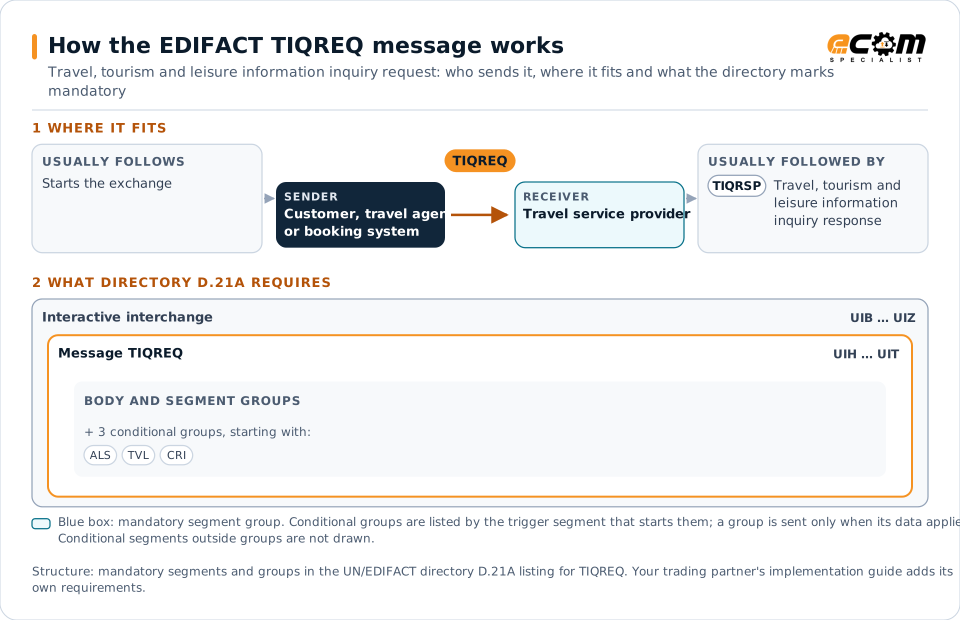
How to read this diagram: the top row shows who sends TIQREQ, to whom, and which messages usually come before and after it. The lower part shows what the directory D.21A itself requires: the envelopes around TIQREQ and the segments and segment groups it marks mandatory. Conditional groups are listed by their trigger segment rather than drawn in full. This is the directory's minimum, not a trading partner's requirement: a message implementation guide usually makes some conditional groups mandatory, restricts the codes and may use an older directory.
When it is used
- Requesting descriptions of hotels or services
- Requesting policies such as cancellation terms
- Requesting facility details for a destination
Where it fits in the message flow
Structure
Mandatory segments in TIQREQ (directory D.21A)
In UN/EDIFACT directory D.21A, the TIQREQ message has 34 segment positions arranged in 4 segment groups. These are the segments and segment groups marked mandatory at message level, in order; a mandatory group is shown with the segment that starts it. Segments inside conditional groups are needed only when the group is used. This is the directory’s requirement, not your trading partner’s: each partner’s message implementation guide names the directory it uses, often an older one such as D.96A or D.01B where the structure can differ, makes some conditional segments mandatory and restricts the codes. This structure comes from one published copy of the directory and has not been independently verified: confirm it before you build a map.
- UIH
- UIT
Practical example
TIQREQ in practice
A corporate travel agent needs to know whether a conference hotel has meeting rooms and accessible rooms. Its system sends the hotel a TIQREQ asking for facility information. The hotel answers with a TIQRSP listing its meeting rooms, capacities and accessible room features.
Implementation
Implementation considerations for TIQREQ
- Distinguish information inquiries from availability requests.
- Cache descriptive content where it changes rarely.
- Handle timeouts gracefully without blocking the user.
- Check which interactive standards each provider supports.
How ECOM helps
Automate TIQREQ with ECOM
Industry
Hospitality
Procurement, invoicing and supplier integration for hotels, restaurant groups and foodservice suppliers.
Solution
Batch and Real-Time Integration
Scheduled batch processing and real-time, API-driven integration on one platform.
Solution
API Integration
Connect partner and application APIs to your systems and bridge them with EDI processes.
Compare X12 and EDIFACT, or see answers to general questions in the EDI FAQ.
Related messages
Related travel and tourism messages
- TIQRSPTravel, tourism and leisure information inquiry response
- PASREQTravel, tourism and leisure product application status request
- PASRSPTravel, tourism and leisure product application status response
- TUPREQTravel, tourism and leisure data update request
- TUPRSPTravel, tourism and leisure data update response
- AVLREQAvailability request
- AVLRSPAvailability response
- RESREQReservation request
- RESRSPReservation response
- SKDREQSchedule request
- TSDUPDTimetable static data update
- RESMSGReservation
Need help with TIQREQ?
ECOM maps, tests and monitors EDIFACT messages for your trading partners and integrates them with your ERP.