
B2B communication protocols
HTTP/HTTPS connections for B2B data
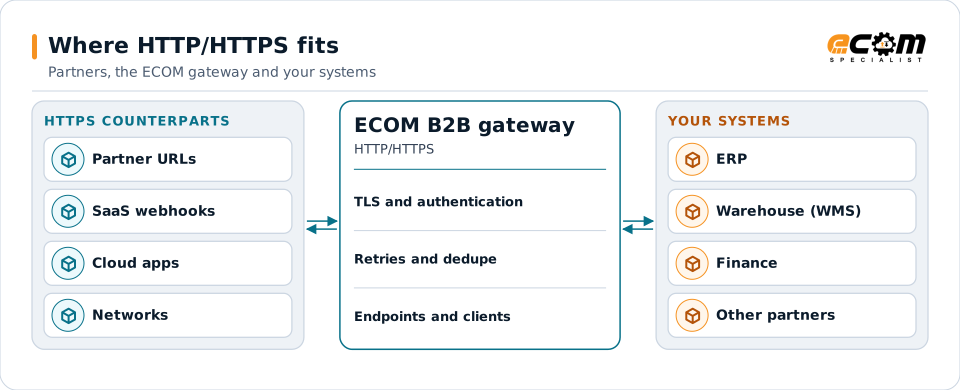
HTTPS is the transport underneath AS2, AS4, web services, REST APIs and simple file posting. Some partners exchange documents by posting them straight to a URL. ECOM sets up HTTPS connections in both directions, with the security and retries business data needs.
- Standard
- HTTP with TLS (HTTPS)
- Ports
- Usually 443 for HTTPS
- Authentication
- Basic, tokens, API keys, client certificates
- Used under
- AS2, AS4, SOAP, REST, webhooks
HTTPS traffic in both directions passes through the gateway, which secures, retries and maps it.
Overview
What HTTP/HTTPS is
HTTP is the request-and-response protocol of the web. A client sends a request, such as POST with a document in the body, and the server answers with a status code, such as 200 for success. HTTPS adds TLS, encrypting the connection and letting the client verify the server's certificate.
In B2B, HTTPS is used directly when a partner provides a URL to post documents to, or calls your URL when it has something for you. It is also the foundation of AS2, AS4, SOAP and REST.
Where businesses use it
Direct document posting
Partners that accept EDI or XML posted to a URL.
Webhooks
Applications that notify you by calling your URL when an event happens.
Foundation for other protocols
AS2, AS4, SOAP and REST all run over HTTPS.
How it works
How an HTTPS exchange works
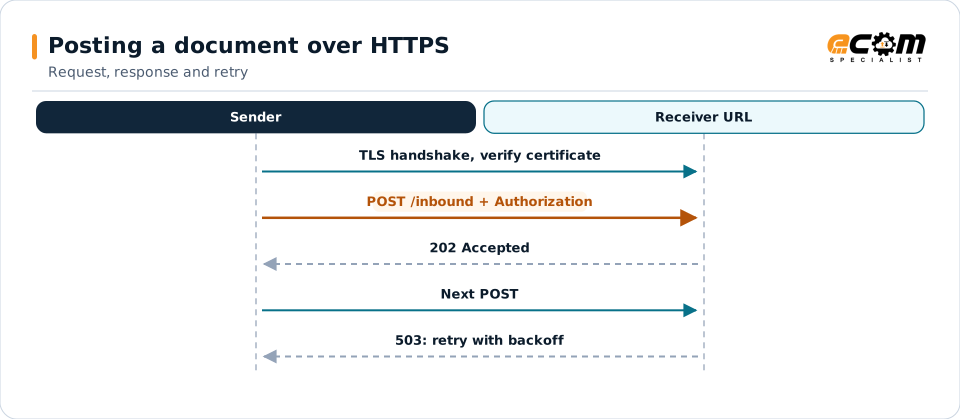
The client opens a TLS connection, verifies the server's certificate, and sends a request with a method, a path, headers (including authentication) and a body. The server returns a status code, headers and an optional body.
Status codes drive what happens next: 2xx means accepted, 4xx means the request was wrong (bad data, failed authentication) and should not be retried as is, 5xx or a timeout means a temporary problem that should be retried.
A 2xx response means accepted. A temporary error such as 503 is retried; a 4xx error is investigated, not retried.
In depth
HTTPS for business data
TLS settings
TLS 1.2 or 1.3 with current ciphers, and certificate verification on every connection.
Authentication
Basic authentication over TLS, API keys, OAuth tokens or mutual TLS with client certificates, as the partner requires.
Status codes and retries
Temporary errors are retried with increasing delays; permanent errors raise alerts.
Idempotency
Message IDs prevent a retried request from creating a duplicate document.
Payload size and timeouts
Large documents may need longer timeouts, compression or chunking, agreed with the partner.
Webhook security
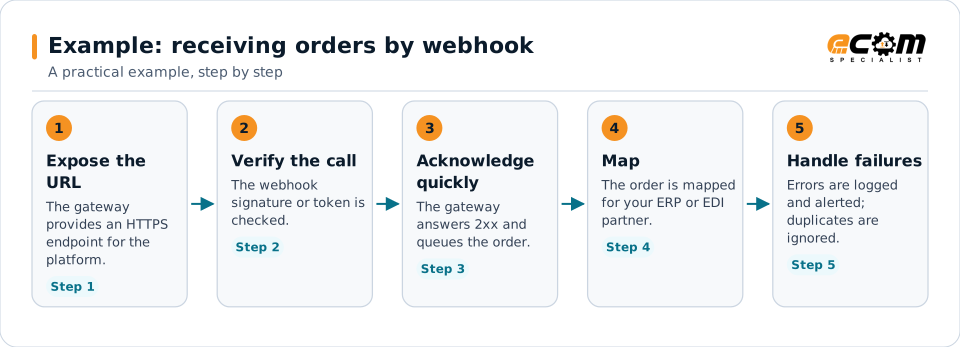
Incoming webhooks are verified with signatures or tokens before they are accepted.
In practice
Example: receiving orders by webhook
A sales platform calls your URL whenever a new order is placed.
Answering quickly and processing afterwards keeps the sender from timing out and resending.
Connections
How HTTP/HTTPS connects your business
Trading partners
Partners that post or receive documents by URL.
Applications
SaaS and cloud applications through webhooks and endpoints.
APIs
REST and SOAP services on the same foundation.
ERP
Data reaches your systems mapped and validated.
ECOM
How ECOM supports HTTP/HTTPS
ECOM supports HTTP/HTTPS with dedicated implementation, mapping, communication and support teams, and with specialists who know the industries your partners work in.
Implementation team
Plans the HTTP/HTTPS setup with you, configures it on the gateway and runs the tests with your partners and systems.
Mapping team
Builds and maintains the maps, code conversions and validation rules between partner data and your applications.
Communication team
Sets up and monitors partner connections, certificates, keys and credentials, and coordinates changes with each partner.
Support team
Watches the flows, investigates failed or missing documents, and works the issue through with you and your partner.
For HTTP/HTTPS in particular
- HTTPS endpoints for partners and webhooks, and HTTPS clients for posting to partners.
- Authentication, certificate and retry settings per counterpart.
- Partner onboarding for HTTP/HTTPS: exchanging connection details, testing in both directions and confirming the go-live date with each partner.
- Monitoring of every connection, with alerts for failed, missing or unacknowledged transfers.
Frequently asked questions
Is posting documents over HTTPS as good as AS2?
HTTPS encrypts the connection, but it does not sign the document or return a signed receipt. AS2 adds those, which is why many partners require it for EDI.
Can plain HTTP still be used?
Only where the content is protected in another way, as with AS2 messages encrypted with S/MIME. HTTPS is strongly preferred.
How are retries handled?
Temporary failures are retried with increasing delays; message IDs prevent duplicates. Permanent errors raise alerts for review.
Can ECOM receive webhooks for us?
Yes. The gateway exposes HTTPS endpoints, verifies each call and maps the data to your systems.
Talk to an EDI/API Expert
Tell us which partners, systems and HTTP/HTTPS requirements you are working with. An ECOM specialist will review them with you and outline the setup, the maps and the tests.