
EDI and B2B standards
NAESB data exchange for the energy industry
The North American Energy Standards Board (NAESB) publishes business practice and electronic communication standards for wholesale natural gas, wholesale electric and retail energy markets. ECOM connects energy companies to their counterparties using NAESB transport rules and maps the data to their systems.
- Published by
- North American Energy Standards Board
- Industry
- Natural gas, electricity, retail energy
- Transport
- NAESB electronic delivery mechanism over HTTPS
- Data
- Nominations, scheduling, invoices, customer enrollments
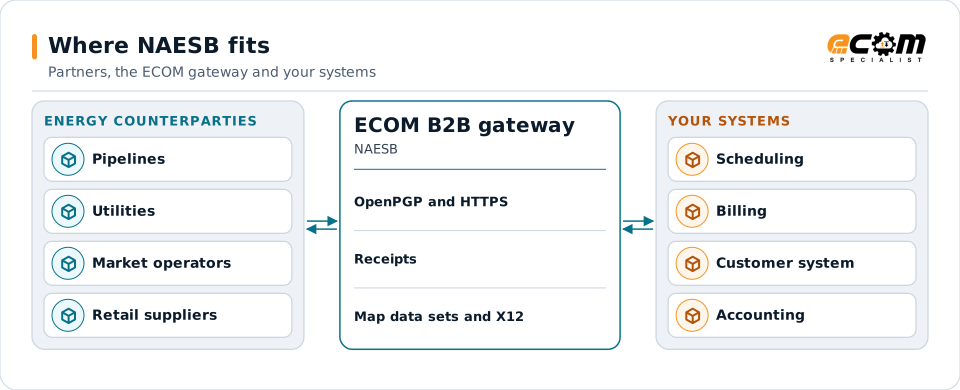
Energy counterparties exchange encrypted NAESB transactions with the gateway, which decrypts, acknowledges and maps them for your systems.
Overview
What NAESB is
NAESB is an industry standards body for North American energy markets. Its quadrants cover wholesale gas, wholesale electric and retail markets. Its standards define business practices, the data sets exchanged between companies, and how they are transmitted.
A central piece is the electronic delivery mechanism: a defined way to send files between trading partners over the internet, with the payload encrypted using OpenPGP and receipts returned to the sender. Retail energy markets in several states exchange customer enrollment, usage and billing data in X12 formats following NAESB and state rules.
Where businesses use it
Wholesale natural gas
Shippers and pipelines exchange nominations, scheduled quantities, confirmations and invoices.
Retail energy markets
Retail suppliers and utilities exchange enrollments, usage and billing documents, often as X12 814, 867, 810 and 820.
Electric markets
Business practices and data exchange between market participants under NAESB wholesale electric standards.
Structure
How NAESB data exchange works
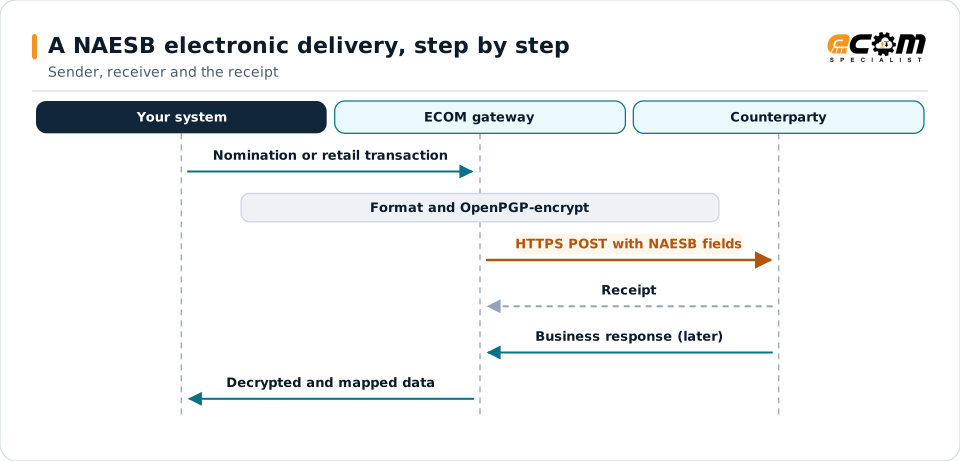
The sender prepares the data set in the format the standard or market defines, encrypts it with the receiver's OpenPGP public key, and posts it over HTTPS to the receiver's URL with the NAESB form fields that identify the transaction. The receiver returns a receipt, and later any business response.
Because the payload is encrypted with OpenPGP and the connection uses TLS, the data is protected both in transit and while it waits to be processed. Each counterparty publishes its URL, public key and technical details to its partners.
The file is encrypted before it leaves, posted over HTTPS, and acknowledged with a receipt. Business responses, such as a confirmation, come as separate transactions.
In depth
What NAESB connections involve
OpenPGP keys
Each party publishes a public key; ECOM manages your key pair, imports partners' keys and tracks expiration and replacement.
HTTPS endpoints
Partners post to your URL and you post to theirs; certificates and firewall rules are set up for each counterparty.
Receipts and errors
Receipts confirm delivery; error responses identify problems such as decryption failures, which are investigated with the partner.
Data sets and X12
Gas data sets and retail X12 documents are mapped to your scheduling, billing and customer systems.
Market rules
Retail markets add state and utility rules on top of NAESB; maps follow the market's implementation guide.
Monitoring
Missing receipts and late business responses are flagged so deadlines are not missed.
Mapping
How a mapper reads and writes NAESB
NAESB as input
After decryption, the map reads the data set or X12 document, checks it against the market's rules, and creates records in your scheduling, customer or billing system.
NAESB as output
Outbound data from your systems is formatted to the data set or X12 guide, then encrypted and posted.
What the mapping handles
Fields
Contract, location, quantity and date fields are mapped to your records.
Loops
Repeating locations, meters or usage periods become rows.
Validation
Required fields, code values and quantities are checked before sending.
Code conversions
Location and meter identifiers are converted between systems.
Business rules
Deadlines and cycles from the market rules are applied.
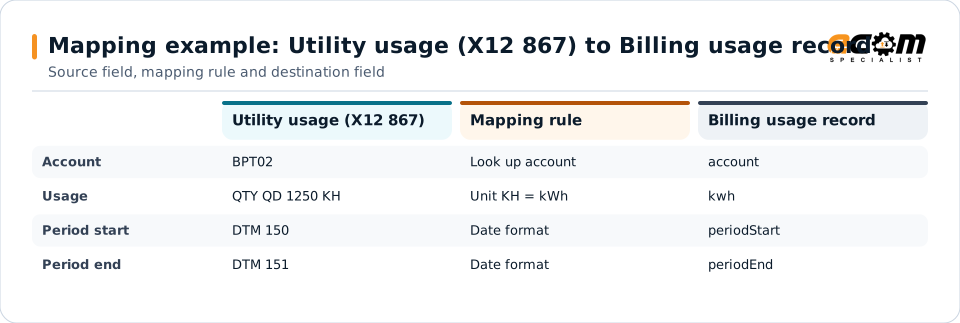
Example: source, mapping, destination
BPT*00*U12345*20261101*DD~
PTD*SU~
QTY*QD*1250*KH~
DTM*150*20261001~
DTM*151*20261031~{
"account": "U12345",
"kwh": 1250,
"periodStart": "2026-10-01",
"periodEnd": "2026-10-31"
}A usage document from a utility becomes a billing record. Qualifiers tell the map which date is the start and which is the end.
Connections
How NAESB connects your business
Pipelines and utilities
Counterparties publish their NAESB endpoints and keys; ECOM sets up each connection.
Scheduling and billing
Nominations, confirmations, usage and invoices flow into your energy systems.
Customer systems
Retail enrollments and changes update customer records.
Finance
Invoices and payments reconcile with your accounting system.
ECOM
How ECOM supports NAESB
ECOM supports NAESB with dedicated implementation, mapping, communication and support teams, and with specialists who know the industries your partners work in.
Implementation team
Plans the NAESB setup with you, configures it on the gateway and runs the tests with your partners and systems.
Mapping team
Builds and maintains the maps, code conversions and validation rules between partner data and your applications.
Communication team
Sets up and monitors partner connections, certificates, keys and credentials, and coordinates changes with each partner.
Support team
Watches the flows, investigates failed or missing documents, and works the issue through with you and your partner.
For NAESB in particular
- NAESB electronic delivery connections, including OpenPGP key management and HTTPS endpoints.
- Maps for wholesale gas data sets and retail energy X12 documents.
- Monitoring for receipts and market deadlines.
Frequently asked questions
What is the NAESB electronic delivery mechanism?
It is NAESB's standard way to transmit data between energy trading partners: the file is encrypted with OpenPGP, posted over HTTPS with defined fields, and acknowledged with a receipt.
Does NAESB use X12?
Retail energy markets commonly exchange X12 documents, such as the 814 for enrollments and the 867 for usage, under NAESB and state market rules. Wholesale gas uses NAESB-defined data sets.
Who manages the encryption keys?
ECOM can manage your OpenPGP key pair and partners' public keys, including expiration tracking and replacement, as part of the connection setup.
Can ECOM connect us to several pipelines or utilities?
Yes. Each counterparty is set up with its own endpoint, keys and rules, and all of them run through the same gateway.
Talk to an EDI/API Expert
Tell us which partners, systems and NAESB requirements you are working with. An ECOM specialist will review them with you and outline the setup, the maps and the tests.