Executive summary
The situation and ECOM’s role
A smaller manufacturer sells to customers that require EDI. ECOM is its comprehensive EDI services provider, so the company can meet those requirements without building a large internal EDI team.
EDI complexity depends on a manufacturer’s customers rather than its size, which is the question a smaller company should put to a provider.
EDI complexity depends on your customers, not on your size.
Customer environment
- Industry
- Manufacturing, at the smaller end of the market.
- ECOM scope
- Comprehensive EDI services.
About this profile: the customer is not named and details are generalized. What is stated about the customer comes from ECOM; text marked “industry context” describes how this kind of business typically works. No volumes, timelines, figures, quotes or measured results are published.
The challenge
Large-customer EDI requirements without a large IT team
Industry context: the EDI obligations of a large manufacturer arrive without its resources. Someone has to build maps, test with each new partner, monitor transmissions, answer a rejection late on a Friday and keep up when a customer changes its requirements. In a smaller company that person usually has another job as well, and the work stops when they are away.
Industry context: item numbers, units of measure, packaging and ship-to detail have to match what each customer expects, or documents are rejected and shipments delayed.
Why ECOM
EDI operations as a service
ECOM provides comprehensive EDI services for the company. The comparison for a smaller manufacturer is between hiring and retaining specialists for a part-time workload and using a provider’s specialists as a service. A managed model also reduces a hidden risk, which is EDI knowledge held by one or two people.
Industry context
Smaller manufacturer
A smaller manufacturer sells to customers that require EDI. The customers decide the requirements, regardless of how large the manufacturer is, and orders can carry detailed requirements through every document.
Customers set the EDI bar
Each customer publishes its own document, format and timing requirements, and changes them over time.
No large IT team
EDI work is usually one part of someone’s job, so it stops when that person is away.
Orders carry detail
Order data, acknowledgments and ship notices carry customer requirements, and an error can delay a job.
Where it goes wrong
Typical problems in this kind of exchange
-
Requirements arrive without the resources
A customer’s EDI requirements do not scale down for a smaller supplier.
Onboarding a new customer competes with the rest of the work.
-
Knowledge sits with one or two people
Maps, partner rules and workarounds live in individual heads and inboxes.
Absence or turnover puts the exchange at risk.
-
Rejections come at bad times
A customer’s system can reject a document at any hour.
A job slips until someone notices and fixes it.
What ECOM provides
The confirmed scope of services
-
EDI operations
ECOM runs the EDI exchange with the customer’s trading partners.
About EDI operations
What ECOM is responsible for
- ECOM provides comprehensive EDI services to the manufacturer.
- Which activities, such as partner onboarding, mapping, monitoring and exception handling, sit with ECOM’s team follows the agreed scope.
Architecture
Where the integration sits
Manufacturer environment
- Order and shipping systems
- Finance
ECOM responsibilities
- Comprehensive EDI services
Customers
- Customers that require EDI
Educational diagram of this kind of environment, not the customer’s own architecture.
Running a similar exchange? Tell us your partners, systems and where the delays are, and a specialist will suggest where to start.
Talk to an EDI/API ExpertThe workflow
How the work flows
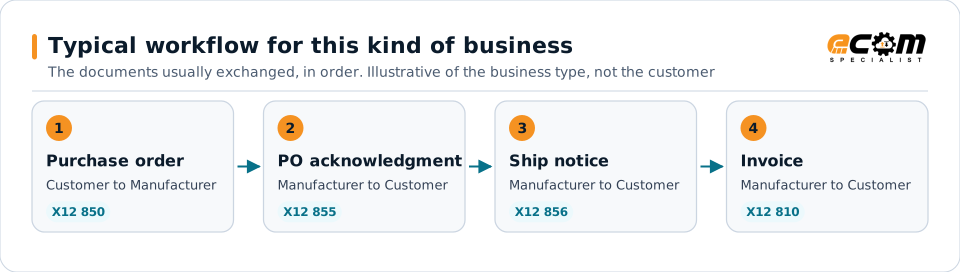
The documents typically exchanged in this kind of business, in the order they usually move. Partners vary, and some connect by API instead of EDI. The shaded line under a step shows where ECOM’s services act.
Steps are listed in the order the documents usually move, with who sends each one.
-
1. Order
Purchase orderX12 850
Customer Manufacturer
The customer places an order that carries its requirements.
Partner onboarding, mapping, monitoring and exception handling for this exchange sit with ECOM’s team.
-
2. Confirm
Order acknowledgmentX12 855
Manufacturer Customer
Confirms what will be made and when, or flags differences.
-
3. Ship
Advance ship noticeX12 856
Manufacturer Customer
Announces the shipment so the customer can receive it.
-
4. Invoice
InvoiceX12 810
Manufacturer Customer
Bills the shipped order against the customer’s purchase order.
ECOM’s role
Operational needs and ECOM’s role
What this kind of exchange needs, and what ECOM does about it within the agreed scope.
Exception handling
When something goes wrong
-
A document is rejected
A customer’s system rejects an acknowledgment, ship notice or invoice.
The team that operates the exchange sees the rejection and works it with that customer’s requirements.
-
A customer changes its requirements
A customer updates its document or format rules.
How a requirement change is handled depends on the agreed scope.
Business value
Confirmed scope and intended benefits
Confirmed
- ECOM is the comprehensive EDI services provider for a smaller manufacturer.
Intended benefits
- EDI operations without a dedicated internal team.
- EDI knowledge held by a team rather than by one or two people.
Systems typically involved
- Customer systemsSend orders and receive confirmations, ship notices and invoices.
- The manufacturer’s order, shipping and finance systemsHold orders, shipments and invoices.
Lessons for similar enterprises
What other organizations can take from this
Customers set the EDI bar
Size does not reduce what customers require.
Price the real cost of in-house EDI
Include absence, turnover and part-time workloads.
Ask about the late Friday rejection
Ask a provider who responds when a partner rejects a document after hours.