
X12 transaction guide · Finance
EDI 223 Consolidators Freight Bill and Invoice
The X12 document a freight consolidator uses to send invoice and freight bill data for consolidated shipments.
- Sent by
- Freight consolidator
- Received by
- Shipper or bill-to party
- Standard
- ANSI ASC X12
What is an EDI 223?
The EDI 223 Consolidators Freight Bill and Invoice is the ANSI X12 transaction set a freight consolidator uses to send invoice and freight bill data to the responsible party. The freight bill services may be performed by the consolidator itself or by a motor carrier unrelated to it.
The 223 always carries the consolidator's invoice; it must not be used to send freight bill data on its own. Consolidators combine small shipments from several shippers into fuller loads, so the invoice allocates charges back to each shipment.
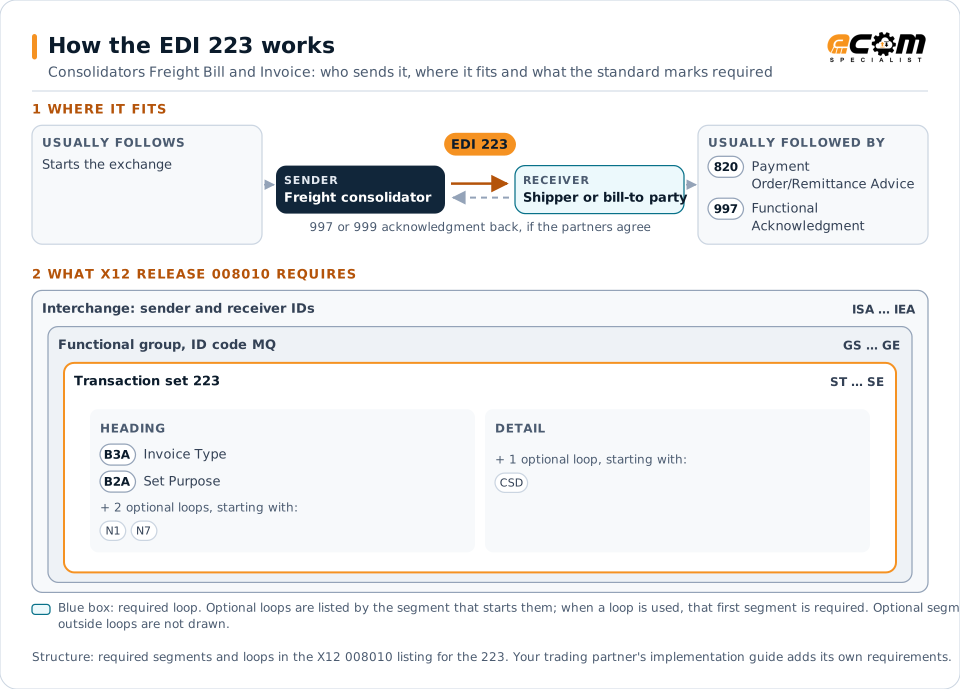
How to read this diagram: the top row shows who sends the 223, to whom, and which documents usually come before and after it. The lower part shows what X12 release 008010 itself requires: the envelopes around the 223 and the segments and loops the standard marks as required, area by area. Optional loops are listed by the segment that starts them rather than drawn in full. This is the standard's minimum, not a trading partner's requirement: each partner's implementation guide usually makes some optional loops mandatory, restricts the codes and may use a different release.
When it is used
- Billing shippers for consolidated freight
- Invoicing charges allocated from a consolidated load
- Passing through linehaul charges from an underlying carrier
Where it fits in the document flow
Structure
Mandatory segments in the 223 (X12 release 008010)
The segments X12 release 008010 marks as mandatory at their level, in order. Segments inside optional loops are needed only when the loop is used. This is the standard's requirement, not your trading partner's: each partner's implementation guide names the release it uses, adds the optional segments it requires and restricts the values. The requirement status comes from one published X12 reference listing and has not been checked against a second source.
- ST
- B3A
- B2A
- N1
- N7
- CSD
- OID
- LX
- SE
Practical example
The 223 in practice
A consolidator combines pallets from eight apparel vendors into full truckloads bound for a retailer's distribution center. It sends each vendor a 223 for its shipments, with the consolidated load reference, the vendor's share of the linehaul charge based on weight and the handling fee. The vendors' payables teams audit and pay the invoices.
Implementation
Implementation considerations for the 223
- Explain how consolidated charges are allocated to each shipment.
- Reference both the consolidated load and the shipper's own shipment identifiers.
- Remember the 223 must carry invoice data, not just freight bill detail.
- Audit allocations against the agreed consolidation rates.
How ECOM helps
Automate the 223 with ECOM
Industry
Trucking and Transportation
Load tenders, responses, status and freight invoices for carriers, brokers and shippers, integrated with the TMS.
Solution
Financial Document Automation
Automate invoices, remittances, payment files and bank statements from capture to posting.
Industry
Retail
Retail and eCommerce EDI for suppliers and retailers, from purchase order to payment, with compliance built in.
More general questions about EDI are answered in the EDI FAQ.
Related transactions
Related finance documents
- 820Payment Order/Remittance Advice
- 110Air Freight Details and Invoice
- 224Motor Carrier Summary Freight Bill Manifest
- 859Freight Invoice
- 290Cooperative Advertising Agreements
- 412Trailer or Container Repair Billing
- 414Rail Carhire Settlements
- 424Rail Carrier Services Settlement
- 810Invoice
- 812Credit/Debit Adjustment
- 818Commission Sales Report
- 822Account Analysis
Need help with the EDI 223?
ECOM maps, tests and monitors X12 documents for your trading partners and integrates them with your ERP.