
X12 transaction guide · Finance
EDI 412 Trailer or Container Repair Billing
The X12 document used to invoice the responsible party for repairs to trailers and containers transported by railroads.
- Sent by
- Repair facility or railroad
- Received by
- Party responsible for the repair, such as the equipment owner or user
- Standard
- ANSI ASC X12
What is an EDI 412?
The EDI 412 Trailer or Container Repair Billing is the ANSI X12 transaction set that lets a repair provider invoice the responsible party electronically for repairs to trailers and containers moved by railroads. It identifies the equipment, the damage, the repairs performed with their labor and material costs, and the party billed.
Intermodal trailers and containers are inspected and repaired at ramps and terminals. Responsibility depends on who had the equipment when the damage occurred, so repair bills reference inspection records. Electronic billing lets equipment owners audit large volumes of small repair invoices against their own rules.
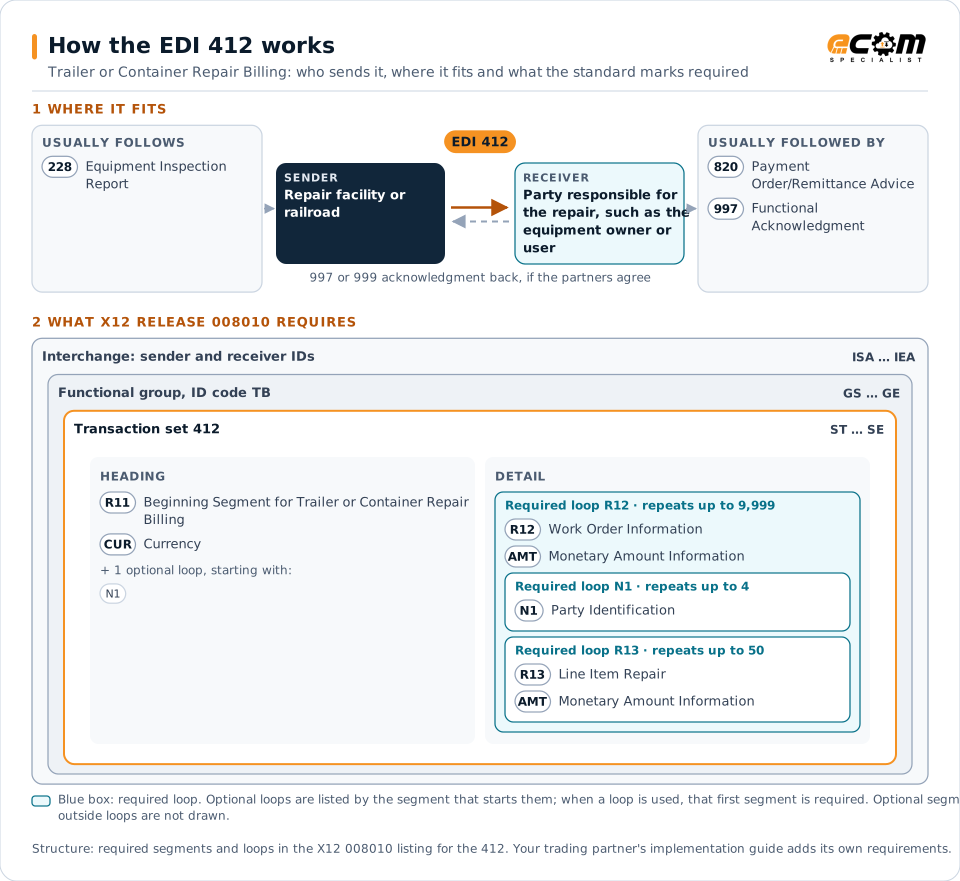
How to read this diagram: the top row shows who sends the 412, to whom, and which documents usually come before and after it. The lower part shows what X12 release 008010 itself requires: the envelopes around the 412 and the segments and loops the standard marks as required, area by area. Optional loops are listed by the segment that starts them rather than drawn in full. This is the standard's minimum, not a trading partner's requirement: each partner's implementation guide usually makes some optional loops mandatory, restricts the codes and may use a different release.
When it is used
- Billing equipment owners for trailer or container repairs
- Charging repair costs to the party responsible for damage
- Supporting audits of repair charges
Where it fits in the document flow
Structure
Mandatory segments in the 412 (X12 release 008010)
The segments X12 release 008010 marks as mandatory at their level, in order. Segments inside optional loops are needed only when the loop is used. This is the standard's requirement, not your trading partner's: each partner's implementation guide names the release it uses, adds the optional segments it requires and restricts the values. The requirement status comes from one published X12 reference listing and has not been checked against a second source.
- ST
- R11
- CUR
- N1
- R12
- AMT
- R13
- SE
Practical example
The 412 in practice
A container at an intermodal ramp is found with a damaged door seal and is repaired by the ramp's maintenance contractor. The contractor sends the container owner a 412 with the container number, the repair codes, labor hours, parts and total cost, referencing the inspection report. The owner audits the bill against its repair price list and pays it.
Implementation
Implementation considerations for the 412
- Use standard repair and damage codes that owners can audit.
- Reference the inspection that identified the damage.
- Identify equipment by its reporting marks and number.
- Agree repair price lists to avoid disputes.
How ECOM helps
Automate the 412 with ECOM
Industry
Trucking and Transportation
Load tenders, responses, status and freight invoices for carriers, brokers and shippers, integrated with the TMS.
Solution
Financial Document Automation
Automate invoices, remittances, payment files and bank statements from capture to posting.
Solution
Logistics Automation
Automate tenders, status updates, freight invoices and warehouse orders with logistics partners.
More general questions about EDI are answered in the EDI FAQ.
Related transactions
Related finance documents
Need help with the EDI 412?
ECOM maps, tests and monitors X12 documents for your trading partners and integrates them with your ERP.