
EDIFACT message guide · Finance
DOCAMR Request for an amendment of a documentary credit
The UN/EDIFACT message an applicant or its bank uses to ask the issuing bank to amend or cancel a documentary credit.
- Sent by
- Applicant or applicant's bank
- Received by
- Issuing bank
- Standard
- UN/EDIFACT · Batch message
- X12 equivalent
- No direct equivalent
What is the EDIFACT DOCAMR message?
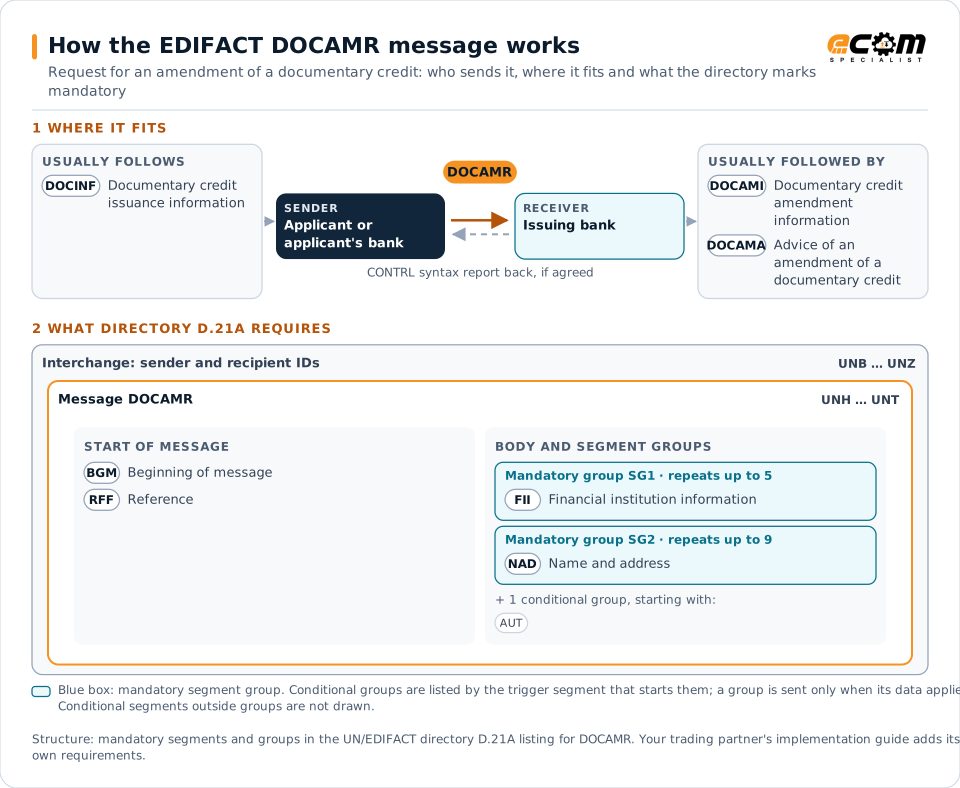
DOCAMR is the UN/EDIFACT request for an amendment of a documentary credit. The directory defines it as a message originated by the applicant, or the applicant's bank, and sent to the issuing bank, requesting it to amend the terms and conditions of an issued documentary credit or to cancel the credit.
Amendments are common when shipment dates slip, quantities change or terms were issued incorrectly. An amendment only takes effect for the beneficiary once it is advised and accepted, which is handled by the following messages in the chain.
How to read this diagram: the top row shows who sends DOCAMR, to whom, and which messages usually come before and after it. The lower part shows what the directory D.21A itself requires: the envelopes around DOCAMR and the segments and segment groups it marks mandatory. Conditional groups are listed by their trigger segment rather than drawn in full. This is the directory's minimum, not a trading partner's requirement: a message implementation guide, such as an industry subset or a partner’s own guide, usually makes some conditional groups mandatory, restricts the codes and may use an older directory.
When it is used
- Extending shipment or expiry dates
- Changing amounts or quantities
- Correcting terms or cancelling a credit
Where it fits in the message flow
Structure
Mandatory segments in DOCAMR (directory D.21A)
In UN/EDIFACT directory D.21A, the DOCAMR message has 20 segment positions arranged in 3 segment groups. These are the segments and segment groups marked mandatory at message level, in order; a mandatory group is shown with the segment that starts it. Segments inside conditional groups are needed only when the group is used. This is the directory’s requirement, not your trading partner’s: each partner’s message implementation guide names the directory it uses, often an older one such as D.96A or D.01B where the structure can differ, makes some conditional segments mandatory and restricts the codes.
- UNH
- BGM
- RFF
- SG1 (FII)
- SG2 (NAD)
- UNT
Practical example
DOCAMR in practice
A vessel delay means an exporter cannot ship by the credit's latest shipment date. The importer's trade finance system sends its bank a DOCAMR extending the shipment and expiry dates by three weeks. The bank amends the credit, confirms with a DOCAMI, and the exporter receives the amendment through its advising bank.
Implementation
Implementation considerations for DOCAMR
- Request amendments early; changes take time to reach the beneficiary.
- Reference the credit number and current terms exactly.
- Coordinate with the exporter, who must accept the amendment.
- Track amendment status through to acceptance.
How ECOM helps
Automate DOCAMR with ECOM
Industry
Financial Services
Secure file transfer and B2B integration for banks and financial institutions.
Solution
Financial Document Automation
Automate invoices, remittances, payment files and bank statements from capture to posting.
Industry
Trucking and Transportation
Load tenders, responses, status and freight invoices for carriers, brokers and shippers, integrated with the TMS.
Compare X12 and EDIFACT, or see answers to general questions in the EDI FAQ.
Related messages
Related finance messages
- DOCINFDocumentary credit issuance information
- DOCAMIDocumentary credit amendment information
- DOCAMAAdvice of an amendment of a documentary credit
- DOCADVDocumentary credit advice
- DOCAPPDocumentary credit application
- DOCAREResponse to an amendment of a documentary credit
- COLREQRequest for a documentary collection
- BUSCRDBusiness credit report
- CREADVCredit advice
- CREEXTExtended credit advice
- CREMULMultiple credit advice
- RECECOCredit risk cover
Need help with DOCAMR?
ECOM maps, tests and monitors EDIFACT messages for your trading partners and integrates them with your ERP.