
EDIFACT message guide · Finance
RECECO Credit risk cover
The UN/EDIFACT message used between factoring companies and their clients to request and grant credit protection on buyers.
- Sent by
- Seller (factoring client) or factoring company
- Received by
- Factoring company or seller
- Standard
- UN/EDIFACT · Batch message
- X12 equivalent
- No direct equivalent
What is the EDIFACT RECECO message?
RECECO is the UN/EDIFACT credit risk cover message. The directory explains that factoring companies provide their clients, the sellers, with protection against the risk of credit losses on sales to buyers, with cover granted for each approved buyer, and the message is used to request, grant, change or cancel that cover.
Sellers need to know how much they can sell to each buyer on protected credit. The factor answers cover requests with an approved limit, which the seller's credit management uses to release orders.
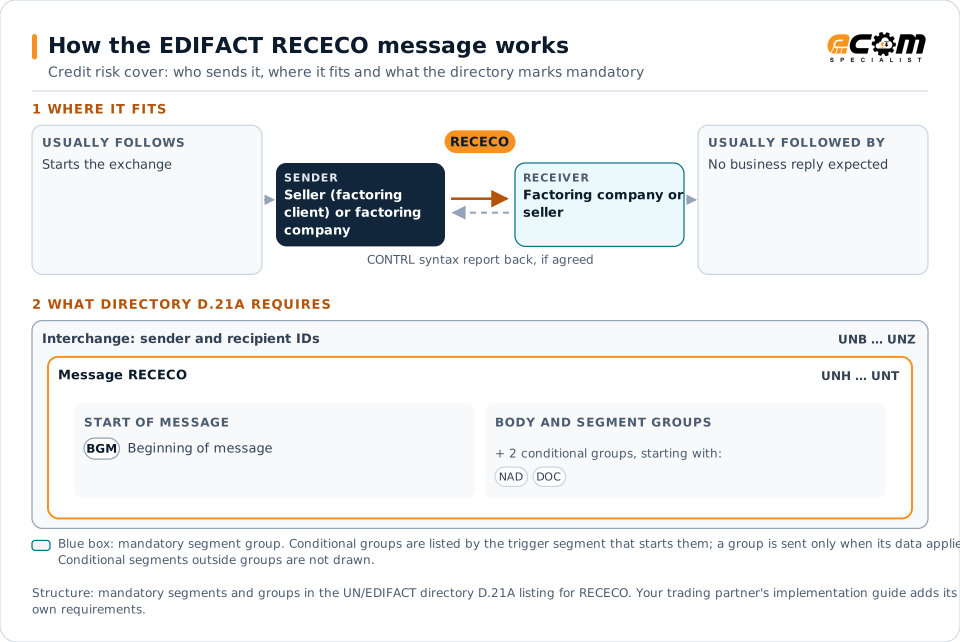
How to read this diagram: the top row shows who sends RECECO, to whom, and which messages usually come before and after it. The lower part shows what the directory D.21A itself requires: the envelopes around RECECO and the segments and segment groups it marks mandatory. Conditional groups are listed by their trigger segment rather than drawn in full. This is the directory's minimum, not a trading partner's requirement: a message implementation guide, such as an industry subset or a partner’s own guide, usually makes some conditional groups mandatory, restricts the codes and may use an older directory.
When it is used
- Requesting credit cover on a new buyer
- Requesting a higher limit for an existing buyer
- Receiving approvals, reductions or cancellations of cover
Where it fits in the message flow
No other message routinely comes directly before or after RECECO; it is exchanged when the business event occurs. If the partners agree, the receiver confirms each interchange with a CONTRL syntax and service report.
Structure
Mandatory segments in RECECO (directory D.21A)
In UN/EDIFACT directory D.21A, the RECECO message has 18 segment positions arranged in 2 segment groups. These are the segments and segment groups marked mandatory at message level, in order; a mandatory group is shown with the segment that starts it. Segments inside conditional groups are needed only when the group is used. This is the directory’s requirement, not your trading partner’s: each partner’s message implementation guide names the directory it uses, often an older one such as D.96A or D.01B where the structure can differ, makes some conditional segments mandatory and restricts the codes.
- UNH
- BGM
- UNT
Practical example
RECECO in practice
A textile wholesaler wins a new retail customer. It sends its factor a RECECO requesting credit cover of 200,000 euros on the buyer. The factor assesses the buyer and replies with approved cover of 150,000 euros, which the wholesaler sets as the customer's credit limit.
Implementation
Implementation considerations for RECECO
- Identify buyers with the identifiers the factor uses.
- Keep approved limits synchronized with credit management.
- Act on reductions or cancellations of cover promptly.
- Follow the factoring agreement's procedures.
How ECOM helps
Automate RECECO with ECOM
Industry
Financial Services
Secure file transfer and B2B integration for banks and financial institutions.
Solution
Order-to-Cash Automation
Automate the flow from purchase order to payment across every customer channel.
Solution
Financial Document Automation
Automate invoices, remittances, payment files and bank statements from capture to posting.
Compare X12 and EDIFACT, or see answers to general questions in the EDI FAQ.
Related messages
Related finance messages
- BUSCRDBusiness credit report
- CREADVCredit advice
- CREEXTExtended credit advice
- CREMULMultiple credit advice
- DOCADVDocumentary credit advice
- DOCAMAAdvice of an amendment of a documentary credit
- DOCAMIDocumentary credit amendment information
- DOCAMRRequest for an amendment of a documentary credit
- DOCAPPDocumentary credit application
- DOCAREResponse to an amendment of a documentary credit
- DOCINFDocumentary credit issuance information
- AUTHORAuthorization
Need help with RECECO?
ECOM maps, tests and monitors EDIFACT messages for your trading partners and integrates them with your ERP.