
Messaging and events
Apache Kafka and Confluent integration
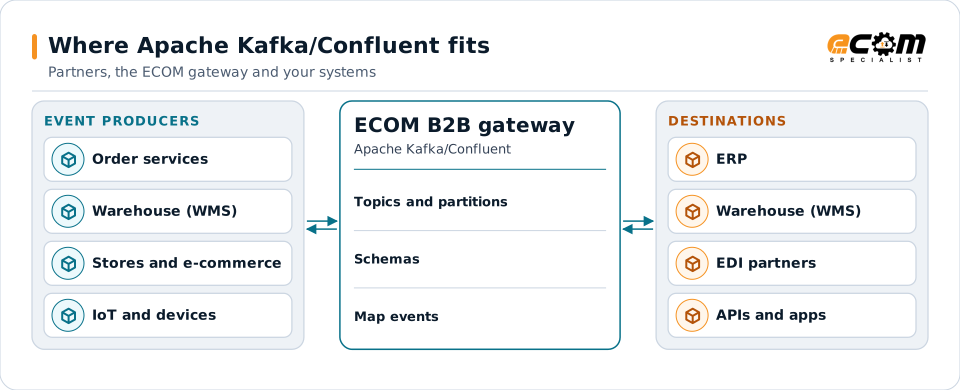
Apache Kafka is an event streaming platform: a durable log of events that many applications read at their own pace. Confluent offers Kafka as a managed cloud service and a platform with schema management and connectors. ECOM streams partner and EDI data into Kafka topics and turns events into partner documents.
- Project
- Apache Kafka (open source)
- Commercial platform
- Confluent Platform and Confluent Cloud
- Model
- Topics, partitions, consumer groups
- Data contracts
- Schema Registry (Avro, JSON Schema, Protobuf)
Events flow through Kafka topics; the gateway turns them into partner documents and back.
Overview
What Apache Kafka/Confluent is
Kafka stores events in topics. Each topic is split into partitions, and each event in a partition has an offset, its position in the log. Consumers read events and record the offset they have reached, so they can stop and resume, and several independent applications can read the same events.
Events are kept for a configured retention period, not deleted when read. That makes Kafka a source of truth for streams such as orders, shipments and inventory changes. Schemas in a schema registry keep producers and consumers agreed on the structure of each event.
Where businesses use it
Order and inventory streams
Every order, allocation and stock change published once and used by many systems.
Data platforms
Feeding analytics, data lakes and dashboards in near real time.
Microservices
Services communicating through events instead of direct calls.
How it works
How Kafka streaming works
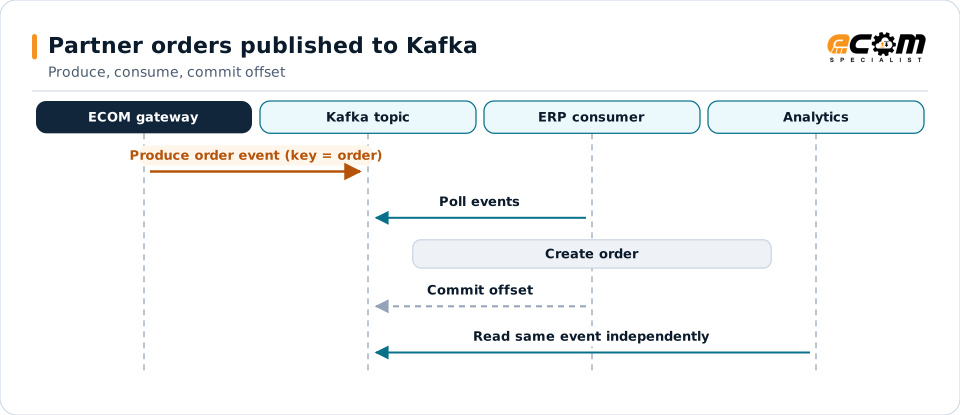
A producer sends an event with a key and a value to a topic. The key decides the partition, so events for the same order stay in order. Consumers in a consumer group share the partitions between them; each partition is read by one member of the group.
Consumers commit offsets after processing. If a consumer fails, another takes over from the last committed offset. Idempotent producers and transactions avoid duplicates where exactly-once processing is needed.
One event serves several consumers. Each one tracks its own offset, so they never interfere.
In depth
Kafka integration in practice
Keys and ordering
Order is kept within a partition, so keys are chosen to keep related events together.
Schemas
Avro, JSON Schema or Protobuf schemas in a registry are used to validate and evolve events.
Delivery guarantees
At-least-once is common; idempotent producers and transactions are used where duplicates must be avoided.
Retention and replay
Events can be replayed from an earlier offset to rebuild or reprocess data.
Security
TLS, SASL authentication and access control lists protect clusters and topics.
Dead-letter topics
Events that cannot be processed go to a separate topic for review.
In practice
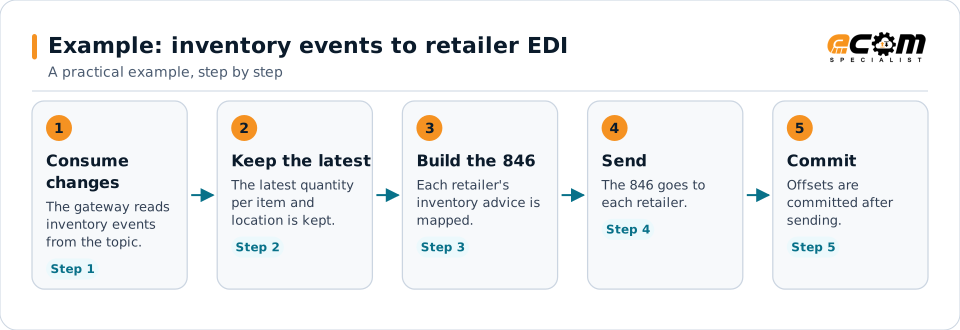
Example: inventory events to retailer EDI
Inventory changes are published to Kafka. Retailers need a daily X12 846.
The stream keeps every change; the 846 gives each retailer the current picture.
Connections
How Apache Kafka/Confluent connects your business
Trading partners
EDI documents from partners become Kafka messages for internal systems, and events become partner documents.
ERP and business systems
Orders, shipments, inventory and invoices move between applications as events, without point-to-point links.
APIs and files
The same data can be published to APIs or written to files for systems that do not read the platform.
Business workflows
Order-to-cash and fulfillment steps react to events as they happen.
ECOM
How ECOM supports Apache Kafka/Confluent
ECOM supports Apache Kafka/Confluent with dedicated implementation, mapping, communication and support teams, and with specialists who know the industries your partners work in.
Implementation team
Plans the Apache Kafka/Confluent setup with you, configures it on the gateway and runs the tests with your partners and systems.
Mapping team
Builds and maintains the maps, code conversions and validation rules between partner data and your applications.
Communication team
Sets up and monitors partner connections, certificates, keys and credentials, and coordinates changes with each partner.
Support team
Watches the flows, investigates failed or missing documents, and works the issue through with you and your partner.
For Apache Kafka/Confluent in particular
- Kafka and Confluent producers and consumers with schema registry integration.
- Topic, key, partition and security design with your platform team.
- Mapping between Kafka messages and EDI, XML, JSON, files and your ERP, with validation.
- Monitoring of queues, subscriptions and failed messages, with alerts and a clear path to reprocess.
Frequently asked questions
Is Kafka a message queue?
Not exactly. Kafka is a durable log: events stay for a retention period and many consumers can read them independently, unlike a queue where a message is removed once consumed.
What is the difference between Kafka and Confluent?
Apache Kafka is the open-source project. Confluent is a company that offers Kafka as a managed cloud service and a platform with additional tools such as schema management and connectors.
Can EDI documents be published to Kafka?
Yes. Partner documents are translated into events with agreed schemas, and events can be turned into partner documents.
How are duplicates avoided?
With idempotent producers, transactions where needed, and keys that let consumers detect repeats.
Talk to an EDI/API Expert
Tell us which partners, systems and Apache Kafka/Confluent requirements you are working with. An ECOM specialist will review them with you and outline the setup, the maps and the tests.