
PRISM-WebEDI · 3PLs and warehousing
WebEDI for 3PLs and warehousing providers
A 3PL operates between the inventory owner, the warehouse, the retailer and the carrier. PRISM-WebEDI is the browser collaboration layer across those relationships. ECOM configures the agreed warehouse, customer, retailer and transportation exchanges, and your staff get a clear workspace for the work that still needs a person. PRISM-WebEDI is already in use by 3PL providers.
Who it serves
Built for 3pls and warehousing providers programs
Multi-client warehouses
Keep each customer’s orders, inventory, documents and rules separate while sharing warehouse practices.
Fulfillment and distribution operators
Turn customer instructions into warehouse work and warehouse events into the documents customers need.
Cross-dock businesses
Connect inbound references to outbound customer requirements.
3PLs supporting brands that sell into retail
Contribute the warehouse’s labels, carton data and shipment details to a retailer’s ASN process.
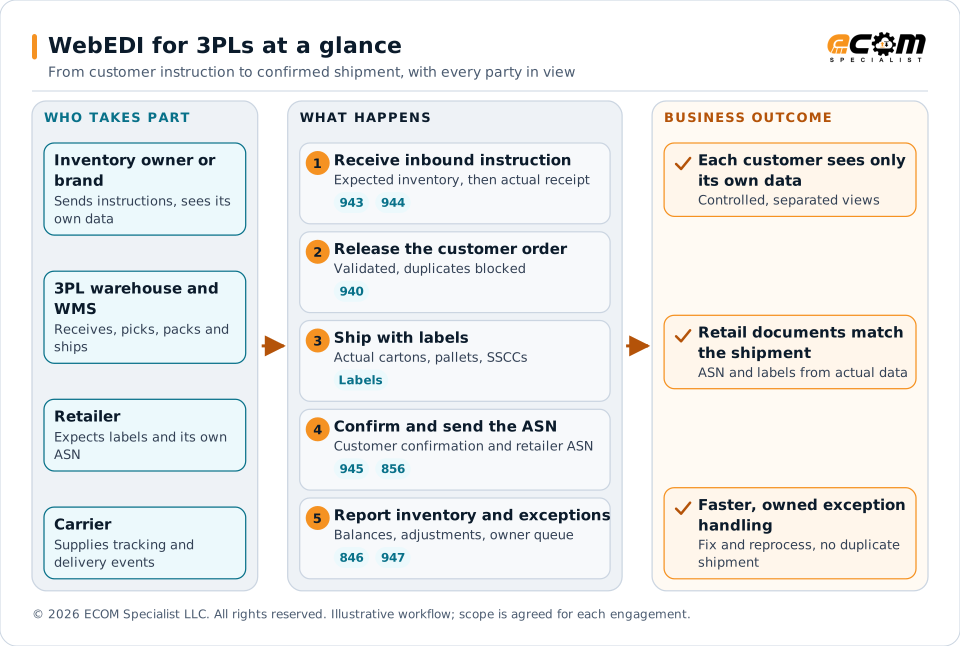
The inventory owner, the 3PL warehouse and its WMS, the retailer and the carrier work through five stages that PRISM-WebEDI organizes: receive the inbound instruction, release the customer order, ship with labels, confirm the shipment and send the retailer ASN, then report inventory and exceptions. The business outcome is that each customer sees only its own data, retail documents match what shipped, and exceptions are handled faster by a named owner.
Challenges
What goes wrong without a tested, connected process
Three relationships, one shipment
The customer, the carrier and the retailer each have different documents. A warehouse shipping confirmation is not automatically a retailer ASN.
Customer separation
One customer’s orders, inventory, documents and rules must stay separate from another’s across screens, searches, exports and integrations.
Retail compliance on behalf of customers
Labels, carton contents, routing references and shipment notices must be right, with clear authority to transmit.
Inventory that customers can trust
On-hand, allocated, available, damaged and quarantined stock are defined differently across systems, and snapshots age.
Exceptions that consume staff time
Unknown items, receipt discrepancies, incomplete shipments and rejected documents need an owner and a next action.
Workflows and documents
The workflow and the documents behind it
PRISM-WebEDI sits around warehouse execution. The WMS normally controls locations, allocations, picking and physical inventory movement; WebEDI provides the agreed instruction, collaboration and document exchange around it.
| Flow | What happens | Typical X12 document |
|---|---|---|
| Inbound instruction | The warehouse is told what inventory to expect | 943 |
| Receipt confirmation | Actual receipt and discrepancies are reported to the owner | 944 |
| Outbound order | Customer instruction becomes a warehouse order | 940 |
| Shipment confirmation | Actual shipped quantities, carrier and tracking are reported | 945 |
| Retail ASN | Carton-level data supports the seller’s ASN | 856 |
| Inventory visibility | Agreed balances and statuses by customer, facility and item | 846 |
| Inventory adjustments | Cycle count, damage or return adjustments are explained | 947 |
Capabilities
What PRISM-WebEDI can cover for a 3PL
Open any item for the detail.
A controlled view for each customerCustomer separation is a central acceptance criterion.
- Customers can see their own orders, receipts, shipment confirmations, inventory reports and exceptions. Internal teams may see the accounts and facilities they are authorized to manage.
- Customer-specific rules include item cross-references, units of measure, ship-from information, approved destinations, document preferences and required shipment references.
- Separation is tested across screens, searches, exports, attachments and integrations.
- Customer branding, delegated user administration, granular facility permissions and customer self-service are options to confirm in scope.
Separate the three business relationshipsDocuments are not interchangeable.
- The customer-to-3PL relationship governs inventory ownership and warehouse instructions; the 3PL-to-carrier relationship governs transportation; the seller-to-retailer relationship governs the commercial order and retailer compliance.
- A warehouse shipping confirmation is not automatically a retailer ASN. A warehouse service invoice is not the manufacturer’s merchandise invoice. A carrier status event is not proof the retailer accepted the inventory.
- The solution design assigns the sender, recipient, business owner and source data for every transaction, so the warehouse is not responsible for an action it has not been authorized to perform.
Inbound instructions and receiptsAdvance information in, actual receipt out.
- Instructions can come from the customer’s structured message, an agreed system interface or a portal entry by an authorized user.
- Useful data includes inventory owner, facility, expected date, reference numbers, item details, quantities and packaging, plus lot, batch, serial, expiry, temperature and handling data where captured.
- Receipts reflect what the warehouse actually received, from the WMS, an authorized portal workflow or another agreed interface.
- Shortages, overages, damage, unidentified items and held inventory create a review task with an owner. Photos and files can be an attachment option.
- Dock arrival, physical receipt, inspection completion and release to saleable inventory are different events and can be reported separately.
- Appointment scheduling, dock assignment, labor planning and yard management remain functions of the WMS or other operational application unless separately scoped.
Customer orders into warehouse workValidated before release, with a clear amendment cutoff.
- Outbound instructions can arrive through EDI, a connected application, an agreed import or a portal form.
- Customer identity, facility, destination, item references, quantities and required dates are validated before release.
- Duplicate rules use the right combination of customer, order reference, version and business context.
- A change before picking is handled differently from one after packing or dispatch. The portal does not imply a customer can cancel goods already loaded onto a carrier.
Picking, packing and shipment confirmationActual shipment data drives customer confirmations and downstream documents.
- After picking and packing, shipped quantities, shortages, carton and pallet relationships, ship date, carrier, service, tracking number, PRO number and bill of lading reference can feed confirmations.
- The design defines which fields staff enter and which come from the WMS or carrier, so staff do not retype data already available.
- If a lighter portal execution workflow is proposed, its exact warehouse functions are demonstrated and confirmed.
Retail fulfillment on behalf of customersThe warehouse contributes labels, cartons and shipment data to the retailer ASN.
- The 3PL records actual shipped items and packaging; the workflow uses it to prepare required shipping documents and supply data for the retailer’s ASN.
- The solution design decides whether ECOM sends the ASN on the seller’s behalf or returns the information to the seller’s system.
- The brand remains the retailer’s supplier unless another arrangement exists. Retailer credentials, sender identities, certification, document ownership and authority to transmit are assigned to the correct trading relationship.
- Carton-level detail must exist at ship time; it cannot be reliably rebuilt from an item total afterward. Validation checks packaging, identifiers, references and destination before release.
Shipping labels and logistics identifiersLabel data matches the shipment notice.
- The configuration defines the label template, printer requirements, packaging level, barcode content and the source of each identifier.
- Where SSCCs are used, parties agree who assigns them, which authorized GS1 company prefix and numbering process applies and how uniqueness is maintained. A reprint reproduces the same logistics-unit identity.
- Printer compatibility, barcode readability, label placement and sample scan results belong in testing. Label generation, scanning or carrier label services may need an additional module or interface, shown in scope.
Inventory visibility and adjustmentsInventory views show their source and their freshness.
- Agreed balances and statuses can be exposed by customer, facility and item, with more attributes where the source system supports them.
- The dashboard shows the time of the last successful update. A snapshot is not described as real-time inventory.
- On-hand, allocated, available, damaged, quarantined and in-transit stock may be calculated differently across systems; ECOM can scope cross-references and exception reporting on a shared basis.
- Adjustments for cycle counts, damage and returns communicate item, quantity, reason and reference. The warehouse controls who may authorize them and which application records the official movement, so the portal does not become a second ledger.
- When balances disagree, the process compares the last aligned balance and subsequent movements instead of posting an unexplained offset.
Transfers, cross-docking and special servicesMovements are linked from sender to receiver.
- For facility transfers, the outbound movement is linked to the expected and actual receipt at the destination, with in-transit stock kept distinct.
- For cross-dock, inbound references connect to outbound customer requirements, depending on the warehouse’s ability to capture the relationships.
- Kitting, relabeling, repacking and assembly can be included as proposed instructions and completion events. Bill of material execution, work-in-process accounting, labor capture and production control are separate functions to confirm with the WMS.
Returns with clear dispositionA return links the authorization, the goods, their condition and the agreed disposition.
- The record distinguishes saleable stock from goods awaiting inspection, repair, disposal or customer instruction.
- A return to the warehouse does not automatically authorize a credit to the buyer; the customer’s commercial and financial process decides credits, refunds and replacements.
- Return images, serial capture, reason codes and disposition approvals are confirmed during discovery and demonstrated before go-live.
Billing evidenceOperational events that explain charges, without assuming a billing engine.
- A billing evidence view, or an integration to the 3PL’s billing application, can carry receipts, storage, picks, cartons, pallets, labeling and special-handling events with customer, facility, date, reference and quantity.
- Rate cards, minimum charges, storage proration, tiered pricing, invoicing, tax and general ledger posting are separately scoped billing integration or extension, unless full rating and billing is demonstrated.
An actionable exception queueIssues grouped by customer, facility, priority and owner.
- Examples: an order with an unknown item, a receipt discrepancy awaiting instruction, an incomplete shipment, a rejected document and an inventory feed that has not updated.
- Each record names the business object, the failed condition, the required next action and the owner. Escalations follow the agreed operating model.
- The dashboard separates physical status from message status: a shipment can have left while its customer confirmation failed, and a transmitted instruction does not prove the warehouse completed the work.
Connect the systems you already useEDI, APIs and file exchange can coexist, with the portal where people review or complete work.
- The scope can connect customer ERP or order systems, the 3PL’s WMS, transportation applications and other agreed services.
- The project documents the source of truth for orders, inventory, shipments, labels and financial records, and for each integration the identifiers, frequency, acknowledgment behavior, retry handling and correction procedure.
- A failed interface should not lead to duplicate warehouse work: reprocessing recognizes accepted transactions and keeps correlation to the original order or shipment.
In practice
3PL example
A multi-client 3PL fulfilling a brand’s retail orderOne physical shipment, separate documents for each relationship.
- The brand sends a fulfillment instruction. The warehouse receives it through its agreed interface and checks the destination and item cross-references before execution.
- The WMS records actual picked quantities and carton contents. That information supplies the customer’s warehouse shipping confirmation and the separately configured retailer ASN workflow, and the labels reference the correct logistics units.
- The brand sees the shipment and any unresolved exceptions in its authorized view.
- The warehouse reports an inventory movement and provides activity data to its billing application. If one outgoing document is rejected, staff correct and reprocess that transaction without creating another physical shipment.
- This example illustrates the intended division of work and requires the relevant integrations and permissions to be implemented.
Business benefits
What this means for the business
Repeatable customer onboarding
Make onboarding and partner compliance a repeatable service for customers with different levels of technical readiness.
Start in the browser, grow into integration
A customer can begin with a browser workflow, exchange selected files, or integrate directly for higher volume.
Clearer visibility for inventory owners
Access to orders, receipts, shipments and exceptions without relying on status requests by email.
Corrections without duplicate work
Reprocess a rejected document without creating another physical shipment.
Measure the 3PL outcome
Review results by customer and facility: a complex retail program may need different controls from simple wholesale distribution. Measure inventory accuracy from agreed physical and system reconciliation evidence, and warehouse productivity from the execution system, so the portal is not credited for outcomes it cannot establish.
- Customer onboarding time
- Manual touches per order
- Customer status inquiries
- Receipt discrepancy resolution time
- Shipment confirmation latency
- ASN first-pass acceptance
- Exceptions outstanding by age
Getting started
Demonstrate your hardest customer workflow
Bring one customer fulfillment instruction, one receipt example, a shipment confirmation, an inventory report and the retailer requirements your warehouse must support, plus your WMS interfaces and the exceptions that cost the most staff time. ECOM uses them to define a focused demonstration and a practical implementation scope.
Frequently asked questions
How does WebEDI help a 3PL?
It turns customer instructions and warehouse events into the business documents each party needs, and gives staff a browser workspace for work that still needs a person. ECOM configures the agreed warehouse, customer, retailer and transportation exchanges.
Does WebEDI replace our WMS?
No. The WMS normally controls locations, allocations, picking and physical inventory movement. WebEDI provides the instruction, collaboration and document exchange around it, and the exact division of work is set in the solution design.
How are customers kept separate in a multi-client warehouse?
Customer separation is a central acceptance criterion. It is tested across screens, searches, exports, attachments and integrations, using intentionally different users and accounts.
Can the 3PL send the retailer ASN?
The solution design decides whether ECOM sends the ASN on the seller’s behalf or returns the information to the seller’s system for transmission. The brand remains the retailer’s supplier unless another arrangement exists.
Is the inventory view real-time?
It shows the time of the last successful update. Scheduled snapshots and event-driven updates provide different freshness, and an old snapshot is never described as real-time.
Does WebEDI handle 3PL billing?
It can supply billing evidence or feed operational events to your billing application. Rate cards, tiered pricing, invoicing, tax and ledger posting are separately scoped unless full billing functionality is demonstrated.
WebEDI by Industry
Other industries
-
Manufacturers working with retailers
Order, acknowledgment, labels, ASN and invoice in one linked browser workflow for retail accounts.
View manufacturers working with retailers -
Retailers working with manufacturers
A supplier portal for orders, acknowledgments, ship notices and invoices, built around your rules.
View retailers working with manufacturers -
Trucking companies
Load tenders, responses, status events, delivery evidence and freight invoices in one browser workspace.
View trucking companies
Talk to an EDI/API Expert about 3pls and warehousing providers
Tell us about your partners, systems and goals. We will outline the scope, the workflow and what you would need to bring.