
X12 transaction guide · Shipping and logistics
EDI 853 Routing and Carrier Instruction
The X12 document used to send detailed routing and carrier information for a route, without authorizing any particular shipment.
- Sent by
- Buyer, consignee or logistics provider
- Received by
- Supplier or shipper
- Standard
- ANSI ASC X12
What is an EDI 853?
The EDI 853 Routing and Carrier Instruction is the ANSI X12 transaction set for transmitting detailed routing and carrier information for a route. It tells the shipper which carrier, mode and service to use for shipments between given origins and destinations, and can carry related instructions such as consolidation points.
Unlike the 754 routing instructions, which answer a specific request about a shipment, the 853 only provides standing routing information. It does not describe a shipping event or authorize a shipment, so shippers keep it as reference data and apply it when they plan loads.
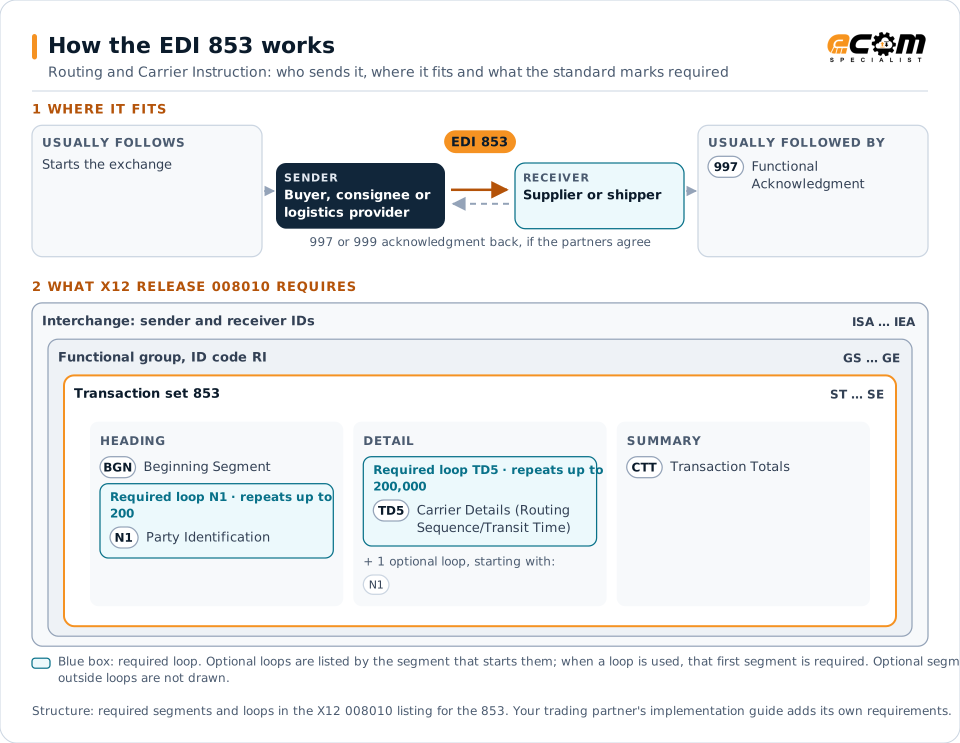
How to read this diagram: the top row shows who sends the 853, to whom, and which documents usually come before and after it. The lower part shows what X12 release 008010 itself requires: the envelopes around the 853 and the segments and loops the standard marks as required, area by area. Optional loops are listed by the segment that starts them rather than drawn in full. This is the standard's minimum, not a trading partner's requirement: each partner's implementation guide usually makes some optional loops mandatory, restricts the codes and may use a different release.
When it is used
- Publishing a customer's routing guide to suppliers
- Assigning carriers and service levels by origin and destination
- Updating routing after a carrier contract changes
Where it fits in the document flow
Structure
Mandatory segments in the 853 (X12 release 008010)
The segments X12 release 008010 marks as mandatory at their level, in order. Segments inside optional loops are needed only when the loop is used. This is the standard's requirement, not your trading partner's: each partner's implementation guide names the release it uses, adds the optional segments it requires and restricts the values. The requirement status comes from one published X12 reference listing and has not been checked against a second source.
- ST
- BGN
- N1
- TD5
- CTT
- SE
Practical example
The 853 in practice
A home improvement retailer renegotiates its inbound freight contracts. It sends each supplier an 853 listing, for the supplier's ship-from points, the carrier and service to use for each distribution center, with the effective date. Suppliers update their shipping systems so that loads tendered after that date go to the right carriers.
Implementation
Implementation considerations for the 853
- Treat the 853 as reference data with effective dates rather than as a shipment instruction.
- Map carrier identifiers (SCACs) and locations to the shipper's own master data.
- Know when to use the 853 versus a shipment-specific 753/754 exchange with each partner.
- Watch for routing guide violations, which retailers often charge back to suppliers.
How ECOM helps
Automate the 853 with ECOM
Industry
Retail
Retail and eCommerce EDI for suppliers and retailers, from purchase order to payment, with compliance built in.
Industry
Trucking and Transportation
Load tenders, responses, status and freight invoices for carriers, brokers and shippers, integrated with the TMS.
Solution
Logistics Automation
Automate tenders, status updates, freight invoices and warehouse orders with logistics partners.
More general questions about EDI are answered in the EDI FAQ.
Related transactions
Related shipping and logistics documents
- 753Request for Routing Instructions
- 754Routing Instructions
- 204Motor Carrier Load Tender
- 210Motor Carrier Freight Details and Invoice
- 856Advance Ship Notice
- 990Response to a Load Tender
- 214Transportation Carrier Shipment Status Message
- 250Purchase Order Shipment Management Document
- 854Shipment Delivery Discrepancy Information
- 858Shipment Information
- 861Receiving Advice/Acceptance Certificate
- 894Delivery/Return Base Record
Need help with the EDI 853?
ECOM maps, tests and monitors X12 documents for your trading partners and integrates them with your ERP.