
X12 transaction guide · Shipping and logistics
EDI 754 Routing Instructions
The X12 document a retailer or its routing provider sends to tell a supplier how to ship an order, including the carrier and pickup details.
- Sent by
- Retailer or buyer (or its routing provider)
- Received by
- Supplier or vendor
- Standard
- ANSI ASC X12
What is an EDI 754?
The EDI 754 Routing Instructions is the ANSI X12 transaction set a buyer uses to send a supplier the routing for a specific shipment. It identifies the ship-from location and, for each shipment, the reference numbers, the carrier by its SCAC code, the pickup date and the purchase orders and quantities the routing covers. It can answer a 753 request for routing instructions or be sent on its own.
Routing instructions are part of buyer-controlled freight programs, where the retailer chooses the carrier to consolidate loads and manage inbound costs. A supplier that ships without following the 754, or ships before the scheduled pickup, can face chargebacks. Like the 753, the 754 first appears in X12 release 4030.
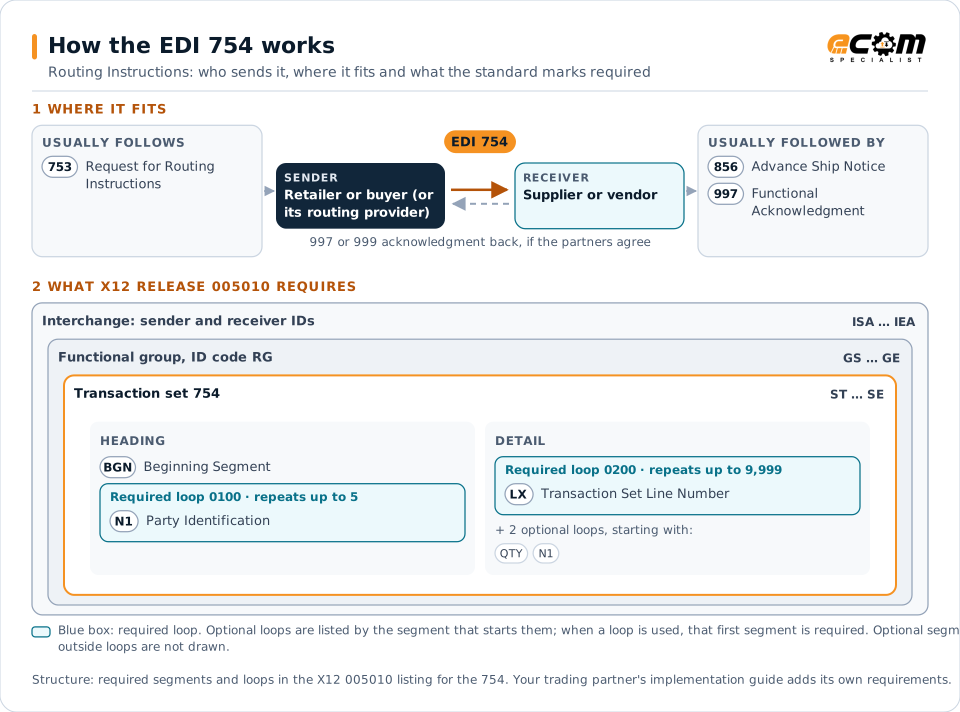
How to read this diagram: the top row shows who sends the 754, to whom, and which documents usually come before and after it. The lower part shows what X12 release 005010 itself requires: the envelopes around the 754 and the segments and loops the standard marks as required, area by area. Optional loops are listed by the segment that starts them rather than drawn in full. This is the standard's minimum, not a trading partner's requirement: each partner's implementation guide usually makes some optional loops mandatory, restricts the codes and may use a different release.
When it is used
- Answering a supplier's 753 request for routing
- Assigning a carrier and pickup date for buyer-controlled freight
- Consolidating several purchase orders into one shipment
- Changing routing after an earlier instruction
Where it fits in the document flow
Structure
Key segments in the 754
The segments most implementations use, described in plain language. The last column shows what X12 release 005010 itself requires: "Required" marks a segment the standard requires in every 754; "Optional, common" marks a segment the standard leaves optional, or that sits in an optional loop, but that implementations often use. This is the standard's requirement, not your trading partner's: each partner's implementation guide names the release it uses, makes some optional segments mandatory and restricts the values, and requirements can differ between releases. The requirement status comes from one published X12 reference listing and has not been checked against a second source.
| Segment | Name | What it carries | In X12 005010 |
|---|---|---|---|
| BGN | Beginning Segment | Purpose code, the routing instruction reference number and its date. | Required |
| N1 loop (ship from) | Party Identification | The ship-from location the routing applies to. | Required |
| LX | Transaction Set Line Number | Starts each routed shipment in the detail loop. | Required |
| L11 | Business Instructions and Reference Number | Reference numbers such as the supplier's routing request or a load identifier. | Optional, common |
| BLR | Transportation Carrier Identification | The assigned carrier's SCAC code and when the routing takes effect. | Optional, common |
| G62 | Date/Time | Dates such as the scheduled pickup date. | Optional, common |
| OID | Order Information Detail | The purchase orders, quantities, weight and volume included in the routed shipment. | Optional, common |
Example
Sample EDI 754
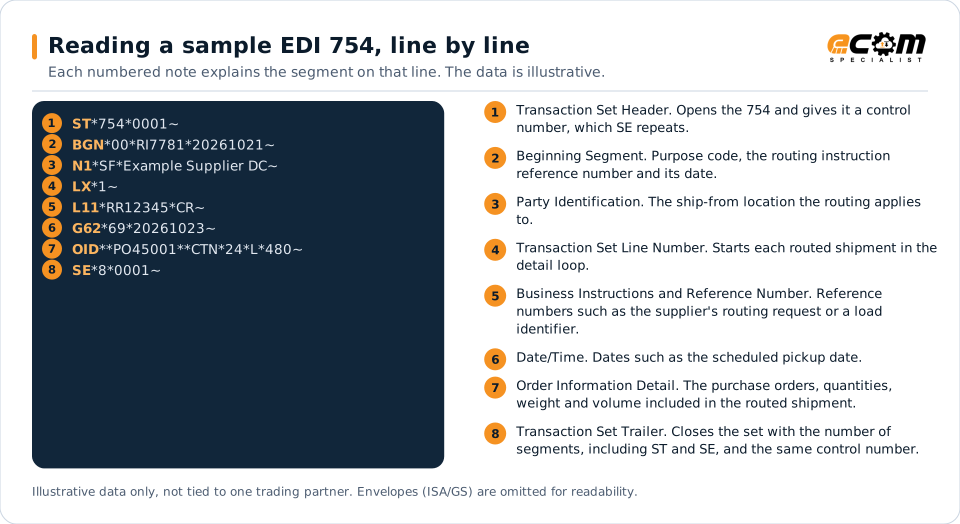
An original (00) routing instruction answering request RR12345 (L11 qualifier CR). It schedules a pickup (G62 qualifier 69) on 23 October for 24 cartons on PO45001. Real 754s also name the carrier, typically by its SCAC code in the BLR segment.
Illustrative data only, not tied to one X12 release or trading partner. The interchange (ISA/IEA) and functional group (GS/GE) envelopes are omitted for readability.
ST*754*0001~
BGN*00*RI7781*20261021~
N1*SF*Example Supplier DC~
LX*1~
L11*RR12345*CR~
G62*69*20261023~
OID**PO45001**CTN*24*L*480~
SE*8*0001~The sample is the same one shown above, with a note beside each segment the first time it appears. Segment IDs are highlighted at the start of each line; the fields after them are separated by asterisks, and each segment ends with a tilde.
Avoid problems
Common 754 errors and how to prevent them
Shipping with the wrong carrier
Using a carrier other than the one in the 754 usually breaks the retailer's routing guide and can lead to freight chargebacks. Route the instruction to the shipping team automatically.
Not matching replies to requests
Each 754 should be matched to the 753 it answers. Unmatched or duplicate instructions need review before goods are released.
Ignoring changed routing
A later 754 can change an earlier instruction. Use the latest instruction for each shipment and keep the history for disputes.
Trading partners
Integration guides that include the 754

How ECOM helps
Automate the 754 with ECOM
Industry
Retail
Retail and eCommerce EDI for suppliers and retailers, from purchase order to payment, with compliance built in.
Industry
Trucking and Transportation
Load tenders, responses, status and freight invoices for carriers, brokers and shippers, integrated with the TMS.
Solution
EDI Integration
Exchange X12 and EDIFACT documents with partners and integrate them directly with your ERP.
EDI 754 FAQs
What does a supplier do after receiving a 754?
It books or prepares the pickup with the assigned carrier, ships on the scheduled date and then sends the ship notice (856) that the retailer requires.
Is a 754 always a reply to a 753?
No. It often answers a 753, but a buyer can also send routing instructions without a request, for example for a standing pickup schedule.
How is the carrier identified in a 754?
Usually by its Standard Carrier Alpha Code (SCAC), carried in the BLR segment, so suppliers and carriers can match the instruction to the right company.
More general questions about EDI are answered in the EDI FAQ.
Related transactions
Related shipping and logistics documents
- 753Request for Routing Instructions
- 856Advance Ship Notice
- 853Routing and Carrier Instruction
- 861Receiving Advice/Acceptance Certificate
- 204Motor Carrier Load Tender
- 210Motor Carrier Freight Details and Invoice
- 990Response to a Load Tender
- 250Purchase Order Shipment Management Document
- 854Shipment Delivery Discrepancy Information
- 858Shipment Information
- 894Delivery/Return Base Record
- 895Delivery/Return Acknowledgment or Adjustment
Need help with the EDI 754?
ECOM maps, tests and monitors X12 documents for your trading partners and integrates them with your ERP.