
PRISM UniChannel
Marketplace and Private Marketplace Management
Expand, connect and control your sales channels from one hub. UniChannel integrates your catalog, inventory and orders with public and private marketplaces, so listings stay accurate and each channel runs under the same rules.
The big picture
Public channels and private portals, managed together
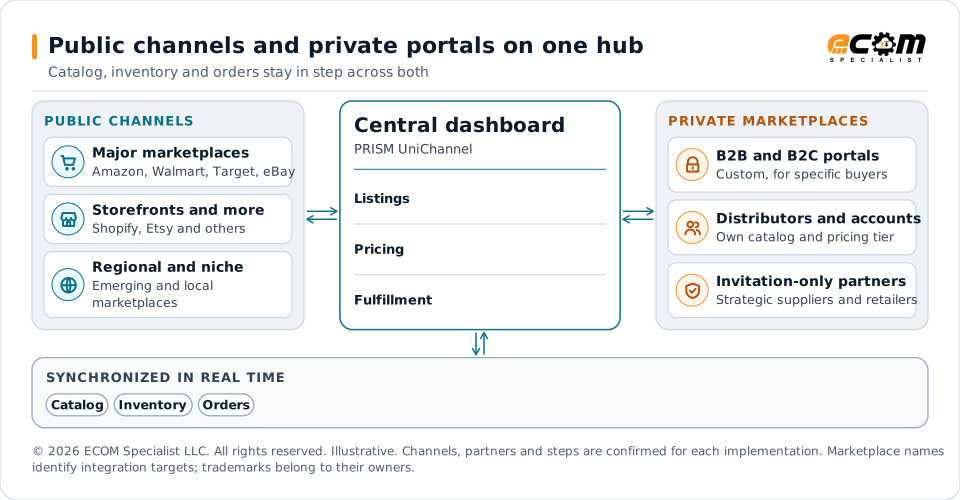
A public marketplace gives you reach. A private marketplace gives you control over who can buy, what they see and what they pay. UniChannel manages both from one interface, so your catalog, inventory and orders stay consistent wherever you sell.
Public channels give you reach, and private marketplaces give you control over who buys and at what price. One dashboard manages listings, pricing and fulfillment for both, and real-time synchronization keeps the catalog accurate and orders intact.
Marketplace and channel connectivity
Connect the channels you sell on
Native integrations reach major channels, with a route to regional and niche marketplaces as well.
-
Major marketplaces and storefronts
Native integrations with Amazon, Walmart, Target, eBay, Shopify, Etsy and other supported channels. ECOM confirms the channels and scope for your program.
-
Regional, emerging and niche marketplaces
A UniChannel program supports rapid onboarding to emerging or local marketplaces, so a new channel is not a new project from scratch.
-
Catalog, inventory and order synchronization
Your catalog, inventory and orders are integrated with each connected channel.
-
Real-time synchronization
Real-time data keeps catalogs accurate and preserves order integrity across your ecosystem.
-
Central management
Manage listings, pricing and fulfillment across every channel from one dashboard.
Private marketplace enablement
Run your own marketplace, on your own terms
A private marketplace is a selling environment you control, for the buyers and partners you choose.
-
Custom B2B and B2C portals
Create and manage custom portals for specific buyers, distributors or corporate accounts.
-
Invitation-only ecosystems
Build invitation-only ecosystems for strategic suppliers or retail partners.
-
Catalog visibility
Decide which catalog each buyer or partner group can see.
-
Pricing tiers
Manage pricing tiers, so different partners see the prices meant for them.
-
Approved-product controls
Manage the approved products available within each ecosystem.
-
Secure, brand-controlled transactions
Streamline transactions inside secure environments that carry your brand and follow your rules.
Practical workflow
From a new channel to a governed one
A practical sequence for adding a channel, public or private.
- Choose the channelA major marketplace, a regional or niche marketplace, or your own private portal.
- Connect the catalogCatalog, inventory and orders are integrated with the channel, with channel-specific attributes.
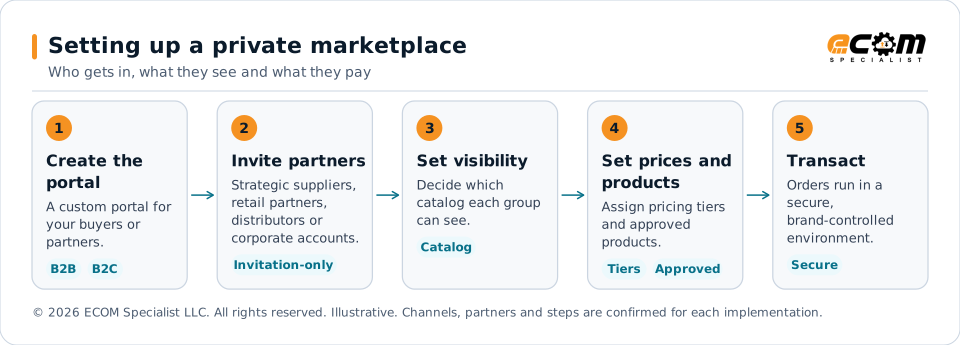
- Set the rulesIn a private marketplace, set who is invited, what they see, the pricing tier and the approved products.
- Go live and synchronizeReal-time data keeps the catalog accurate and orders intact.
- Manage centrallyListings, pricing and fulfillment are managed across channels from one dashboard.
A private marketplace is a set of decisions you control. You create the portal, invite the partners, decide what they can see, set their prices and approved products, and then they transact inside your environment.
Have a specific supplier, marketplace or carrier in mind? ECOM can review your requirements with you.
Business models
Who uses which kind of marketplace
The right mix depends on how you sell.
| Business model | Workflow | Benefit |
|---|---|---|
| Brick-and-mortar retailers | Add online channels alongside the store, with supplier products extending the range. | New reach with the same catalog and inventory. |
| Direct-to-consumer (.com) sellers | Sell through your own store and major marketplaces from one catalog. | A unified brand experience across channels. |
| Small independent shops | Reach marketplaces with easy-to-use automation and managed support. | A way into new channels without a large team. |
| Distributors | Offer corporate accounts and buyers a custom portal with their own catalog and pricing tier. | Controlled selling to known accounts. |
| Suppliers and manufacturers | Join a retail partner’s invitation-only ecosystem, or sell through a portal of your own. | Approved products and defined pricing inside a secure environment. |
Pay-by-scan retailers: see Product, Inventory, Orders and Returns.
Business benefits
The business impact
Faster market entry
Connect a new channel by adding it to the hub you already run.
A unified brand experience
Consistent catalog data, and private portals that carry your brand.
Streamlined channel governance
One place to manage listings, pricing, fulfillment and partner access.
Decision view
Public marketplace or private marketplace?
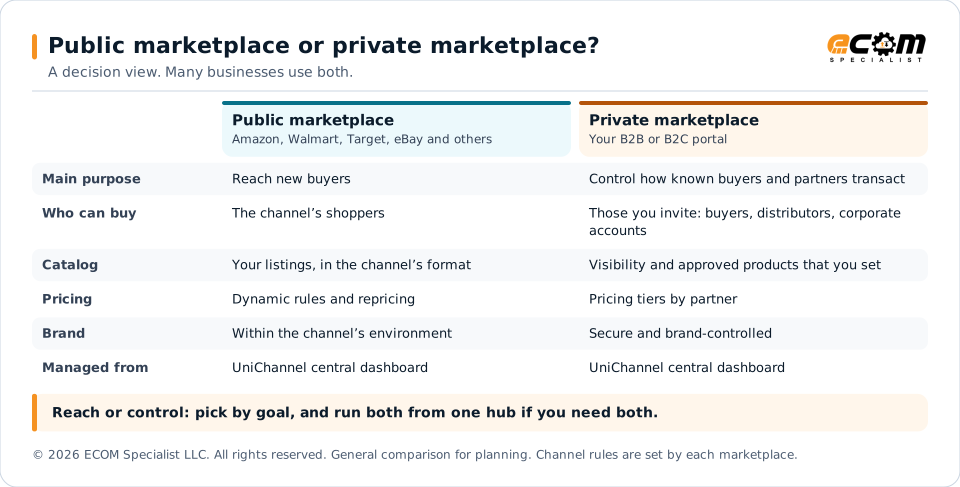
They serve different purposes, and many businesses use both. This view sets out the difference.
Choose a public channel when the goal is reach, and a private marketplace when the goal is control over a known set of buyers or partners. UniChannel manages both from one hub, so this choice does not mean running two separate operations.
Frequently asked questions
Which marketplaces does UniChannel connect to?
UniChannel has native integrations with major channels including Amazon, Walmart, Target, eBay, Shopify and Etsy, plus other supported channels. ECOM confirms the channels and scope for your program.
What is a private marketplace?
A private marketplace is a selling environment you control. You decide who is invited, which catalog they see, which pricing tier applies and which products are approved. Transactions take place inside a secure, brand-controlled environment.
Can we serve B2B and B2C from private portals?
Yes. You can create and manage custom B2B and B2C portals for specific buyers, distributors or corporate accounts.
Can we add smaller or regional marketplaces?
Yes. A UniChannel program supports rapid onboarding to emerging or local marketplaces. ECOM confirms the marketplaces that apply to you during scoping.
Where do we manage listings and prices?
Listings, pricing and fulfillment across channels are managed from one central dashboard.
Plan your channel mix
Tell us where you sell today and which partners or marketplaces you want to add. ECOM will help you scope public and private channels together.
Channels, carriers, ERP versions and enabled capabilities are confirmed for each implementation scope. Third-party names identify integration targets; all trademarks belong to their respective owners. ECOM is not affiliated with or endorsed by them.